

God Handed a Key to a Fallen Star. Why?

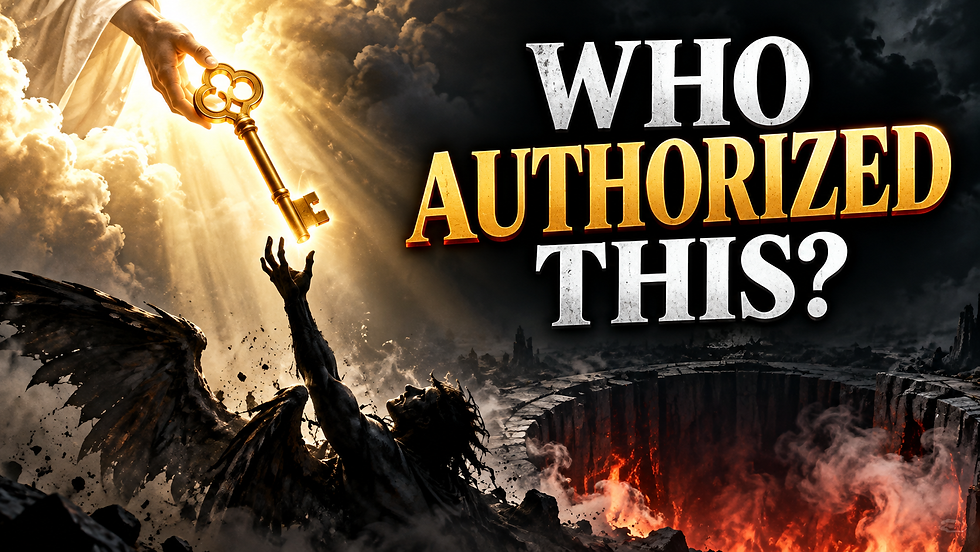
Revelation 9 opens with a fallen star being given the key to the bottomless pit. The passage then describes smoke, strange locust-like beings, scorpion-like power, and a command to torment men rather than destroy vegetation. What exactly was John seeing, and why was this fallen being given access to the abyss?
The language immediately raises questions. John does not simply say that a star came to the earth.
He says that a star fell. That distinction matters. A fall suggests displacement from another realm, and the text quickly confirms that John is not describing an ordinary celestial object. The star is treated as a being. “To him was given the key.” A literal star does not receive a key, exercise authority, or open a prison.
That is where the real tension begins. This being has fallen from heaven, yet he is not immediately restrained. Instead, he is given access to the bottomless pit. The key is handed to him, and he uses it to open what had been shut.
Why?
The bottomless pit in Revelation is not presented as an ordinary earthly location. It is associated with the abyss, confinement, darkness, and spiritual beings. When the pit is opened, smoke rises like the smoke of a great furnace, darkening the sun and the air. Then something comes out of the smoke.
John calls them locusts.
But the more closely you read the description, the less ordinary these locusts become.
What Kind of Locust Comes Out of the Abyss?
Revelation 9 says that the locusts were given power “as the scorpions of the earth have power.” Already, that is unusual. Locusts do not possess the power of scorpions. Then the command becomes stranger still: they are told not to hurt the grass, any green thing, or any tree.
What kind of locust avoids vegetation?
That question sits at the heart of the passage. Ordinary locusts are known for destroying crops and green things. Yet these locusts are specifically forbidden from touching them. Their target is not vegetation but men, particularly those who do not have the seal of God.
The language of the passage also keeps drawing attention to authority. The star was given a key. The locusts were given power. They were commanded what they could touch and what they could not touch. They were permitted to torment, but not to kill. Someone is setting limits. Someone is issuing commands.
This is not uncontrolled chaos. These beings operate under delegated authority.
John then tells us that their torment is like the torment of a scorpion. It becomes so severe that men will seek death and will not find it. Again, the question presses itself upon the reader: what kind of locust behaves this way?
The answer begins to emerge when John describes what they actually looked like.
These Are Not Ordinary Locusts
John says that the shapes of the locusts were “like unto horses prepared unto battle.” On their heads were what appeared to be crowns like gold. The description continues with features that do not belong to agricultural insects.
This matters because we often hear the word locust and immediately import our own mental picture into the text. We imagine the insect we already know. But John is describing what he saw in the language available to him. These beings looked like locusts in some respect, but their behavior, origin, authority, and appearance all point beyond ordinary biology.
They came from the abyss. They were empowered. They were commanded. They targeted men. They carried torment like the sting of a scorpion. They appeared like horses prepared for battle and wore crowns like gold.
These are not ordinary locusts.
These are demonic beings.
The fallen star opened the pit and released beings that had been confined. John was given sight into a spiritual reality that the natural eye would not ordinarily perceive.
And that is where the message becomes more than a study of strange creatures in Revelation.
The Smoke Was a Disguise
When the pit opened, smoke came out first. The smoke darkened the air, but the smoke was not the whole story. Something was moving inside it. Something came through it.
That is the point many believers miss when reading passages like this. The visible thing is not always the full thing. John was shown what lay behind the smoke.
The same principle matters beyond Revelation 9. Scripture repeatedly speaks of a world populated not only by human beings, but also by angels, demons, principalities, powers, and spiritual forces that operate beyond normal human sight. The natural eye sees events. Spiritual discernment asks what is operating behind them.
This does not mean that every event should be explained away as demonic. It means that Scripture does not allow us to reduce reality to what the eye can see.
John saw smoke, but he also saw what the smoke concealed.
That is why spiritual sensitivity matters.
There are times when what is happening around us is deeper than what appears on the surface. The more we insist on seeing only with the natural eye, the less we may actually understand.
The issue is not simply the smoke. The question is what is behind it.


Comments